January 3, 2026
Markets
Markets
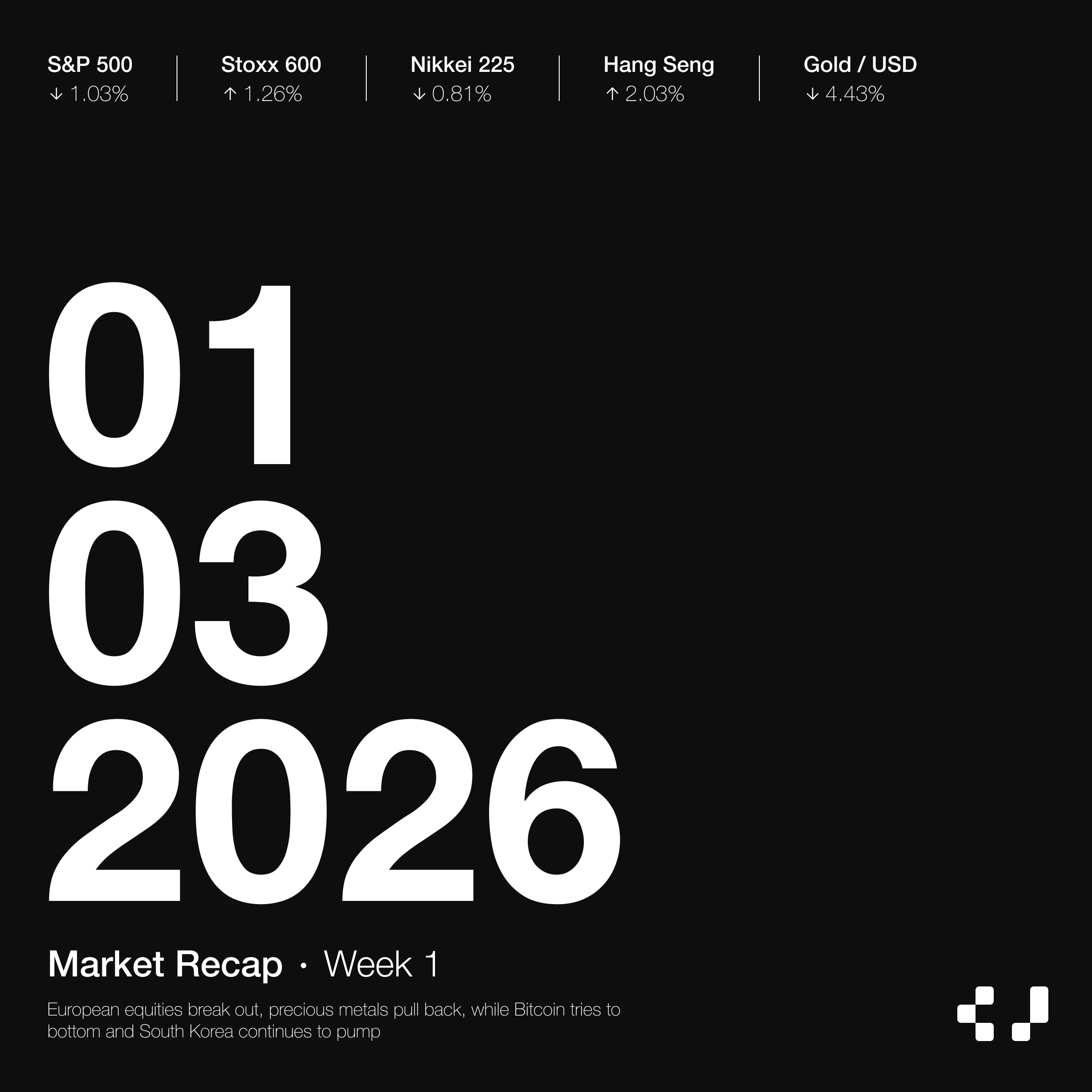
European equities break out, precious metals pull back, while Bitcoin tries to bottom and South Korea continues to pump

Liberation Day, DeepSeek, Trump's memecoin, record-breaking rates in Japan, US government shutdown, and Buffett's goodbye: The stories that shaped 2025
.png)
Another year in the books, and what a year it was. 2025 provided plenty of turmoil, uncertainty, drama, and volatility. It also provided plenty of opportunities to make money with equity markets and precious metals rallying to new record highs, flying in the face of doomsday headlines and historically low consumer sentiment.
The main character of the year was undoubtedly Donald Trump. He took office in January and stayed in the headlines throughout the year, for better and for worse. His primary act of the year was Liberation Day in April, which not only caused the most notable move in financial asset charts of all kinds but also shaped policy and global trade for the rest of the year.
Tariffs weren’t the only story of 2025, though. Below, I’ve tried to sum up the main stories of the year, the ones that had the biggest impact on the economy and financial markets at large.
We kicked off 2025 with Donald Trump taking office once again after ceding the White House to Joe Biden for four years. And he got busy right away, signing executive orders left and right, and kickstarting various initiatives.
For us crypto nerds, perhaps his biggest “initiative” actually took place a few days prior. On January 18th, Trump and team launched the official Trump meme coin ($TRUMP). Now, we’re by no means strangers to meme coins. Nothing new there. But having the soon-to-be president of the United States and arguably most powerful man in the world launch his own seemed absolutely absurd and completely unthinkable just a few months earlier.
The token performed as you’d expect, initially pumping like no meme had ever done before and topping out above $75 billion fully diluted market cap within a day of launch.
What also happened during that first weekend of trading was that Melania Trump joined the party and launched her own $MELANIA coin, sucking out even more liquidity from the crypto market than $TRUMP had already done.
Both tokens are down +90% from the peak and haven’t really been spoken of since the initial launch.
January was also the month when the Chinese DeepSeek launched, seemingly outperforming the leading AI tools like ChatGPT with much less advanced chips and underlying technology. Its abilities put into question the whole AI trade and whether Nvidia would really be able to reach its sales forecast, and if the ‘hyperscalers’ (Alphabet, Microsoft, Meta, etc.) had just been pouring money down the drain by investing so heavily in building out their AI capabilities.
The fear was short-lived, though. Investors started questioning whether DeepSeek had actually achieved what it did on outdated tech. Or maybe they realized that tech companies’ potential ability to do more with less wasn’t necessarily a bad thing. Either way, the Nasdaq’s 3% dip on January 27 looks like a blip on the radar by now.
In February, Trump announced his first round of tariffs as a precursor for what was to come. He slapped tariffs on Canada and Mexico, citing their failure to prevent fentanyl from coming into the US. The tariffs were quickly paused, giving the two countries a chance to solve the issue or negotiate a new deal with the US, but were later reinstated.
A slew of concerning macro data caused the first real test of the ongoing bull market. I wrote a more in-depth post about it, but here’s the brief recap.
First up, the US Services PMI fell to a 2-year low of 49.7 in February, down from 52.9 in January and far below the 53.0 forecast.
Next, US existing home sales decreased 4.9% last month to a seasonally adjusted annual rate of 4.08 million units. Economists had expected a rate of 4.12 million.
Last but not least, US consumer confidence plummeted in February. The latest University of Michigan survey showed the index at 64.7, down 9.8% from January and 15.9% from a year ago. It was also well below the consensus for 67.8.
The S&P 500 sold off 1.7% in one day after the data release and lost 10% over the following three weeks, while the Nasdaq was down 13%. The market stabilized in March but didn’t recover before taking another big hit in April. More on that in a moment.
Another thing high up on Trump’s agenda was ending the war between Russia and Ukraine. As part of that, Volodymyr Zelensky went to the White House to negotiate a potential peace deal. What most people remember from this meeting, however, was the argument between Zelensky on one side and Trump and JD Vance on the other.
Trump and JD basically thought Zelensky was being ungrateful and didn’t understand the seriousness of the situation. Zelensky clearly saw things differently. Luckily, the parties seem to have made up by now, although peace negotiations are not yet finalized.
March was a relatively quiet month, all things considered. But we did get a noteworthy headline out of Germany when the government approved a historic spending package and changes to its long-standing Debt Break Rule (CNBC).
For a country as fiscally conservative as Germany, this was a big deal. However, we’re still waiting to see the full effect of the increased spending.
April was undoubtedly the most important month of the year, due to one single story: Liberation Day.
On April 2nd, Donald Trump announced a sweeping new tariff policy plan on what he called ‘Liberation Day’. The plan included a baseline 10% tariff rate on essentially all imports to the US, but the real kicker was the country-specific tariff rate calculated based on the individual country’s trade deficit with the US.
I wrote a whole Liberation Day recap back then if you’re interested. To sum it up, let’s just say investors did not like what they heard. The country-specific tariff rates ranged from 20% to +40% for some of the United States’ biggest trade partners and were seen as way more aggressive than anticipated and very disruptive to global trade.
Once again, markets reacted as you’d expect. The S&P 500, which was already down 10% from the February peak, plummeted almost 5% on April 3rd, 6% on the 4th, and another 4.7% intraday on Monday, April 7th. The Nasdaq fell 15.5% in that 3-day period.
And then came the U-turn. On April 9th, Trump announced that he would pause all country-specific tariffs for 90 days and instead negotiate new deals with each trade partner. While it would take weeks and months for most of these deals to be settled, and a few more weeks before the China tariffs were even paused, the market response was immediate. The Nasdaq vaulted 12% on the day and kickstarted a massive V-shaped recovery in most equity markets.
When all was said and done, Liberation Day had caused some of the most erratic market moves we’ve ever seen. I’ve gathered just some of the most notable records below.
Arguably the biggest story of May was Warren Buffett announcing his retirement by the end of the year. He simultaneously handed over the role as CEO to Greg Abel (CNBC).
Buffett is perhaps the most famous investor of all time and undoubtedly one of the best. His track record speaks for itself, and his consistency over more than six decades is admirable. Buffett’s retirement is truly the end of an era, although by no means the end of Berkshire Hathaway.
Trump had initially run on a promise of fiscal austerity and bringing down the United States’ massive debt. It didn’t take long for him and the administration to realize just how difficult that would be, though. This essentially caused them to hard pivot to a new goal of boosting the US economy to such a degree that it will outgrow its debt burden.
Elon Musk, who had been brought in to lead D.O.G.E., understandably did not like this plan. Nor was he a big fan of the tariff rollout (also very understandable). In June, this resulted in a very public falling out between him and Trump with name-calling, Epstein accusations, and the like for everyone to behold.
Musk even went so far as to create his own political party, although that now seems to have been just an impulse reaction in the heat of the moment. At least we haven’t heard anything about it ever since.
The two powerhouses cleared things up and seem to be on good footing again, albeit with no direct administration involvement from Musk. His investors seem to be quite okay with this setup.
June was also the month when the US, under Trump’s leadership, dropped a couple of bombs in Iran and then used it as leverage to broker a peace deal in the Middle East. It wasn’t the first time the US carried out an operation like this, and the markets overall didn’t seem to care much.
Trump’s One Big Beautiful Bill was voted into law with a narrow 218-214 majority in the House after several modifications. The bill contained trillions of dollars in tax cuts and beefed-up immigration enforcement spending and was offset by significant cuts to Medicaid and other programs (CNBC).
This bill was also one of the primary signals this year that the Trump administration’s priority was no longer austerity and budget savings, but rather economic growth and innovation.
In 2024, Google was found to hold an illegal monopoly in search. In September of 2025, the US District Court ruled against the most severe consequences proposed by the DOJ, including a forced sale of Alphabet’s Chrome browser.
Investors cheered the ruling and sent Alphabet stock up by 9% on the day in what ended up being a +65% year for $GOOGL.
After being on hold for eight months, the Fed delivered another 25 bps rate cut at the September meeting. This turned out to be the first of three cuts in 2025, bringing the Fed funds rate down from 4.5% to 3.75% after peaking at 5.5% in 2024.
Japan elected Sanae Takaichi as its first female Prime Minister ever, a historic moment in and of itself (CNBC). More important from an investor perspective, however, was her market-friendly policies. One of her first initiatives was a $92 billion stimulus package aimed at helping households deal with inflation (Reuters).
Japan’s stock market had a strong year with the Nikkei 225 hitting new record highs and closing with a +26% gain.
We had another record broken in November when the US government finally ended a shutdown after 43 days. The bill that allowed the government to reopen will only fund operations through the end of January though, so we may be looking at a repeat in a few weeks (CNBC).
When the Bank of Japan hiked rates back in January to 0.5%, it got back to levels not seen since Great Financial Crisis times. With another hike in December, interest rates in Japan reached levels not seen in 30 years (CNBC).
The BoJ is trying to combat high inflation after decades of battling the opposite problem. This development also makes Japan one of the most interesting case studies when it comes to interest rate policy, economic growth, and inflation.
European equities break out, precious metals pull back, while Bitcoin tries to bottom and South Korea continues to pump
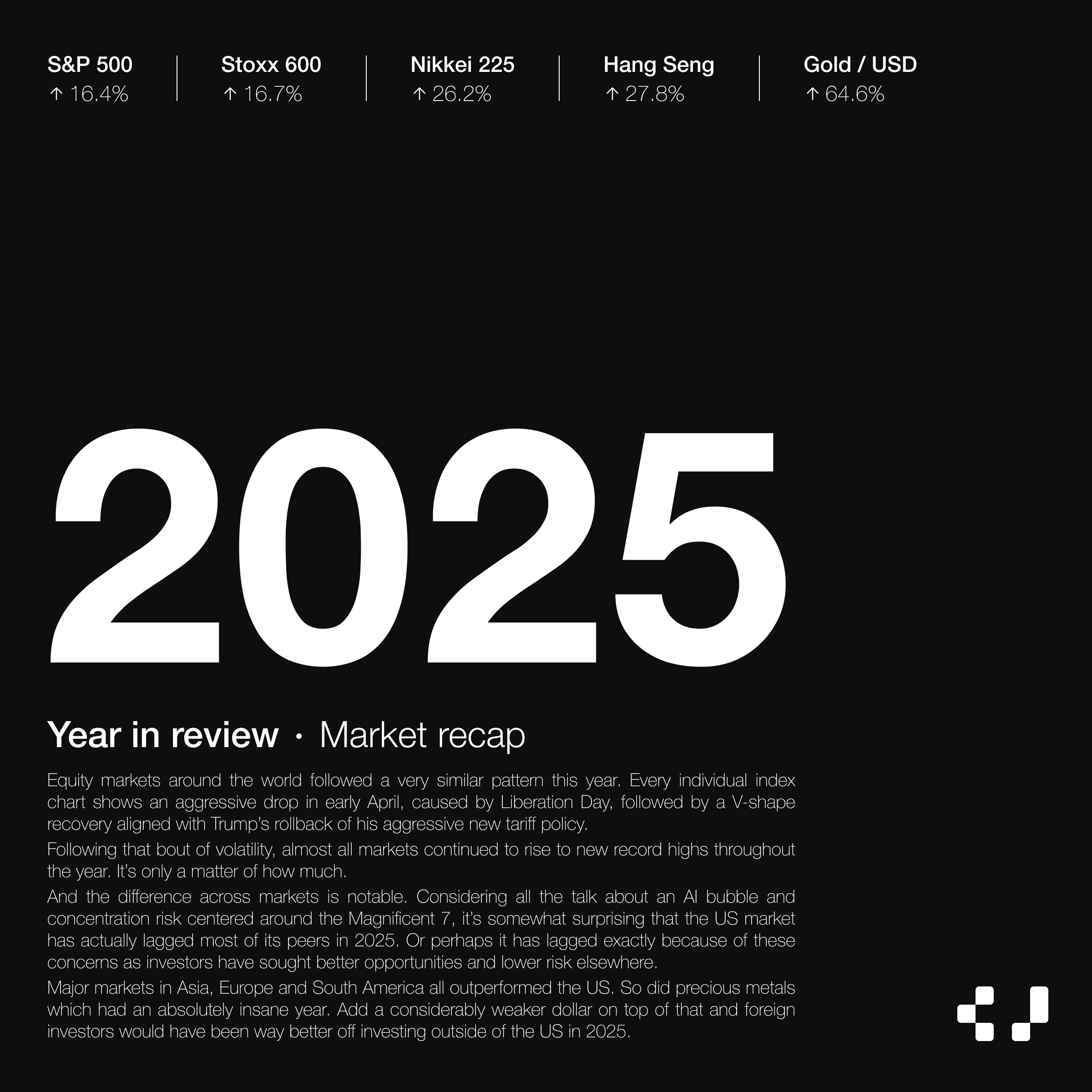
2025 performance review of the key equity indexes, currencies, commodities, and bond yields

The US economy keeps booming, Japan issues yen intervention warning, and Nvidia makes a $20b acquisition